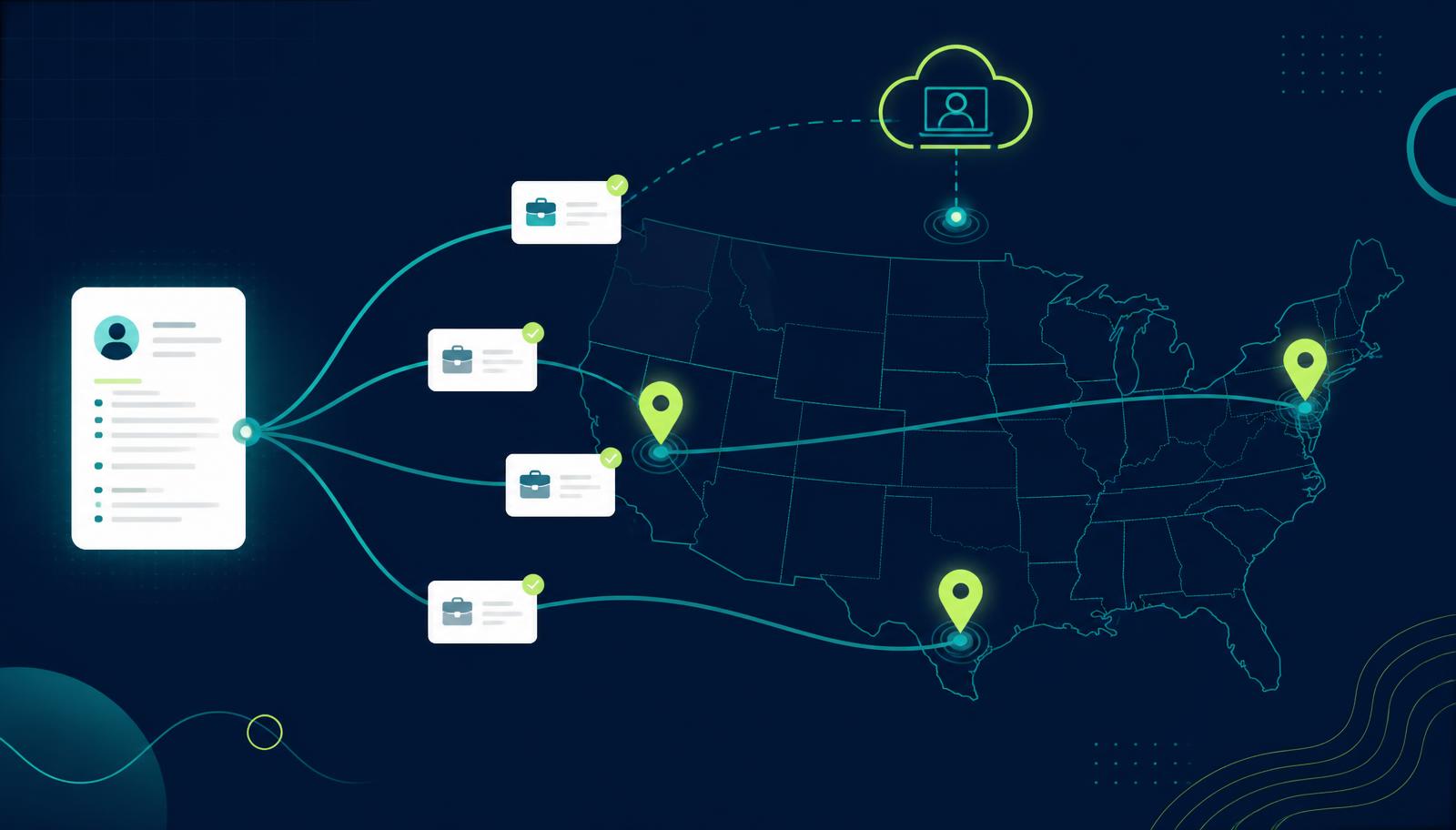
Hands-Off Job Search 2026: Where Apply-Once Lands the Most Interviews (NYC, SF Bay, Austin, Remote)
Hands-off applying works everywhere - but it works fastest in metros with deep corporate hiring footprints. Here's the city-by-city interview-rate playbook for 2026, with citable stats and tips per market.
Why geo still matters in a remote-friendly 2026
Despite the headlines, fully remote work has narrowed back to 12.7% of US job postings (Indeed Hiring Lab, 2025), down from a 2022 peak of ~16%. Most hiring still happens in metros - New York City, San Francisco Bay Area, Austin, Seattle, Chicago, Boston, Denver, Atlanta, Miami, Washington DC, and Los Angeles together account for the majority of US tech, finance, ops, marketing, and design openings.
That's good news for a hands-off job search. A copilot on the Bounce plan can target three metros plus a "remote, US" filter simultaneously - something no human DIY applicant has the bandwidth to do well. Below is the city-by-city interview-rate cheat sheet for 2026.
New York City - finance, media, ad-tech, biotech
NYC is still the highest-volume hiring metro in the US for corporate roles. Highest demand in 2026: finance (Goldman, JPM, Blackstone), media (NYT, Hearst, Bloomberg), ad-tech (TheTradeDesk, Magnite), and the growing biotech corridor (Pfizer, BMS). Median time-to-first-interview on a hands-off cadence with the Bounce plan: 9–14 days.
- Target hybrid 3-day roles - most NYC employers killed fully remote in 2024–2025.
- Set salary floor at NYC market rate (PM/eng base $170k+, finance VP $200k+).
- Set location radius to NYC + Jersey City + Hoboken to capture finance back-office roles.
San Francisco Bay Area - AI, infra, fintech, enterprise SaaS
The Bay is back. AI hiring drove a 38% YoY lift in Bay Area tech job postings in 2025 (Indeed Hiring Lab). OpenAI, Anthropic, Databricks, Stripe, and Notion are all aggressively hiring. Median time-to-first-interview on hands-off: 7–12 days for senior IC roles.
- Include SF, Palo Alto, Mountain View, and San Jose in your location radius.
- AI/ML-adjacent roles get the fastest reply - even non-research PM, design, and ops roles at AI labs.
- Many Bay Area unicorns post on Greenhouse - your resume must parse cleanly there (no tables, no two-column).
Your first 5 applications are free
Stop applying late. We apply the day the job posts.
Most roles fill from the first wave of applicants. JobGooRoo watches new listings, tailors your resume to each one, and submits with your approval while you are still asleep.
About 60 seconds. No credit card.Austin - tech, semiconductors, govtech, healthcare IT
Austin's hiring slowed in late 2024 but rebounded in 2025 with semiconductor expansion (Samsung, NXP), Oracle, Tesla, and a growing govtech cluster. Median time-to-first-interview: 10–16 days. Strong market for mid-senior tech roles without paying NYC/SF housing.
- Round Rock and Cedar Park count as Austin metro for most employers.
- Many Texas employers run Workday - formatting matters; Workday is the strictest parser.
- No state income tax - factor that into your salary floor when comparing offers.
Seattle - cloud, e-commerce, gaming, aerospace
Amazon, Microsoft, and a thick layer of cloud/infra startups still drive Seattle. Boeing and the aerospace supply chain keep hiring engineers and program managers. Median time-to-first-interview on hands-off: 8–13 days. Bellevue is now hiring as much as Seattle proper.
- Target Seattle + Bellevue + Redmond to cover the Microsoft and Amazon footprints.
- Amazon uses internal ATS (BrassRing/iCIMS variants) - keep formatting plain.
- Washington state requires salary in postings - useful for filtering low-ball roles.
Chicago, Boston, Denver, Atlanta, Miami, DC, LA - the second tier
These metros all have deep enough hiring volume to run a hands-off cadence solo. Median time-to-first-interview ranges from 10–18 days depending on seniority and industry.
- Chicago: trading firms (Citadel, Jump), consulting (McKinsey, BCG), healthcare (Abbvie). Strong for finance ops and consulting roles.
- Boston: biotech (Moderna, Vertex), edtech, defense (Raytheon), consulting (Bain). Strongest US biotech metro.
- Denver: cloud + cybersecurity (Palo Alto Networks, Ping), aerospace (Lockheed), outdoor brands. Strong remote-friendly culture.
- Atlanta: fintech (NCR, Truist), media (Cox, Warner Bros Discovery), logistics (UPS, Delta). Lower cost of living, growing tech base.
- Miami: fintech and crypto (Citadel Miami, FTX successors), LATAM-facing roles, real estate tech. Newer hub - interview pace is faster.
- DC: federal contracting (Booz Allen, Deloitte Federal), policy, govtech, cybersecurity. Strong for cleared candidates.
- LA: entertainment tech, e-commerce (Snap, TikTok US), aerospace (SpaceX, Northrop). Long commute radius - set 30-mile cap.
Remote-first companies - the always-on geography
Remote-first employers (GitLab, Automattic, Zapier, Doist, Buffer, Dribbble, Toptal, HashiCorp, Cloudflare's remote orgs, Coinbase, Stripe's remote teams) hire across all 50 states and most run continuous req pipelines. Reply rates on remote-first roles are typically lower (more competition) but the addressable market is the entire country.
- Stack "remote, US" with one specific metro - copilots will dedupe and prioritize first-25 windows.
- Many remote-first employers run Greenhouse or Lever - keep resume to single column, no tables.
- Time zone matters - note your time zone in the cover letter for roles with sync collaboration windows.
- Some remote-first companies require US employment registration in your specific state - check before applying to avoid wasted slots.
How to run hands-off applying across multiple metros without losing fit quality
The biggest mistake DIY applicants make is targeting too many cities at once, which dilutes the signal a copilot uses to match. Here's the configuration that actually works.
- Pick 1 primary metro (where you live or want to live), 1 secondary, and "remote, US" - three buckets total, which is exactly what the Bounce plan volume is sized for.
- Keep target titles tight (3 titles, not 10) - let geo do the volume expansion.
- Re-rank the daily batch by metro priority - primary metro roles get approved first.
- Re-check fit after 14 days - if one metro is sending only ghosts, narrow it or swap it.
- If you accept a relocation, update intake once - the copilot rewrites all future applications around the new base city.
Why Bounce is the right plan for multi-metro hands-off applying
The Bounce plan ($49/month) includes 66 auto-applied jobs per month with priority matching - enough volume to cover three location buckets without thinning out per-role quality. You'll get a daily recap email so you can track which metros are converting and adjust without ever opening a job board.
The first 2 tailored applications are free. Start with Bounce and try it across any of the metros above and see the tailoring quality before you choose a plan.
“Geography still decides reply volume in 2026. The hands-off advantage is that you can target three metros plus remote without ever opening a job board.”
Get Hired Faster with JobGooRoo
Start free with JobGooRoo for the best job search copilot and ATS resume builder. We find and apply for jobs before they hit a job board.
Try hands-off applying with BounceFrequently asked
- Which US city is best for a hands-off job search in 2026?
- By raw volume: New York City, San Francisco Bay Area, and Seattle lead for corporate, tech, and finance roles. By interview speed: SF Bay (AI hiring boom) and Austin (lower competition, strong tech) are fastest in 2026. By cost-adjusted offers: Austin, Denver, Atlanta, and Miami consistently produce the best take-home outcomes.
- Can I run a hands-off job search across multiple cities at once?
- Yes - and you should. The ideal configuration is one primary metro, one secondary, and "remote, US" - three buckets total. A copilot like Roo can apply across all three daily without diluting fit quality. Trying to target more than three metros simultaneously tends to thin out reply rates.
- How many remote jobs are actually available in 2026?
- About 12.7% of US job postings now offer fully remote work (Indeed Hiring Lab, 2025) - down from a 2022 peak of ~16%, but still 8–10× pre-pandemic levels. Hybrid (1–3 days in office) accounts for another ~30% of postings. Fully remote competition is high, so combine remote with one specific metro for best results.
- Does hands-off applying work for senior or executive roles?
- Yes - and the reply rates are often higher than for mid-level roles because senior IC and director-level postings receive less competition per req. The caveat: VP and C-level searches typically use retained recruiters, not job board postings. For director and senior IC, hands-off applying via Bounce or Hop Up consistently delivers interviews.
- Will employers in my city know I used a copilot?
- If the resume reads in your voice, mirrors the JD vocabulary, and the cover letter references something specific about the company, no. Roo's tailoring is designed to read like a strong DIY applicant, not a templated bot. ATS systems care about format and keywords, not whether you typed every word personally.
- How long does it take to start seeing interviews in each metro?
- Median time-to-first-interview on a Bounce-level cadence: SF Bay 7–12 days, NYC 9–14 days, Seattle 8–13 days, Austin 10–16 days, Boston/Chicago/Denver/Atlanta 10–18 days, Miami/DC/LA 12–20 days. Remote-first roles run 14–21 days on average because of higher per-role competition.
More guides
Sent 200 Applications, Heard Nothing? The 2026 Job Market
You sent 200 applications and heard nothing while employers say they can't find talent. Both are true. Here's the 2026 pipeline math - and the three disciplines that actually get interviews.
Job Search StrategyInterview Ghosting: Why Companies Go Silent After You Ace It
You aced the interview. They promised next steps. Then silence. Interview ghosting is rising in 2026 - here's why companies do it and how to stop it from freezing your search.
Job Search StrategyGhost Jobs: How to Spot Listings That Were Never Real
Up to 1 in 5 job listings may never be filled. Here's how to spot ghost jobs, why companies post them, and how to stop pouring your evenings into black-hole applications.