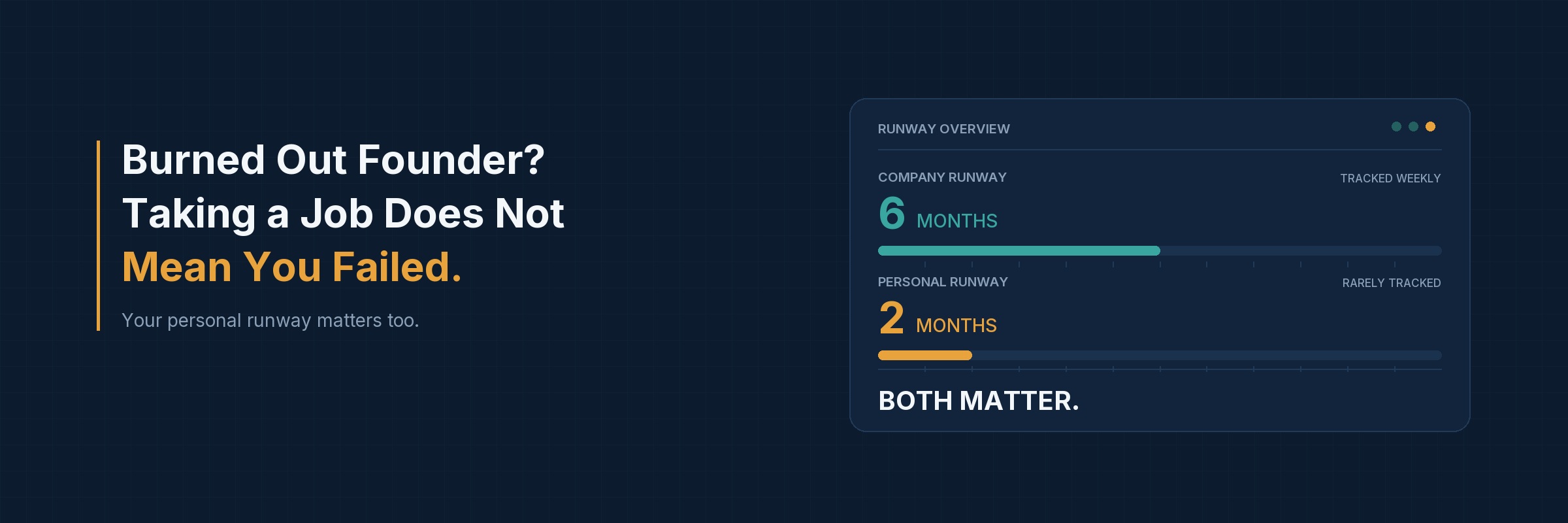
Burned Out Founder? How to Find a Job Without Feeling Like You Failed
You still believe in what you built, and you also need income. Here is how founders re-enter the job market without erasing the startup years or burning what energy is left.
The moment nobody talks about
There is a difficult point in founder life that gets very little attention: the moment when you still believe in what you built, but you also need income.
You may have spent months or years building a company, talking to customers, refining the product, chasing revenue, managing contractors, raising money, hiring, selling, and trying to create something that did not exist before. Then the financial equation becomes impossible to ignore. Savings are thinner. Revenue is slower than expected. Fundraising is uncertain. Your family needs stability. Or you are simply exhausted from carrying too much for too long.
Taking a job at that point can feel like walking backward. It is not. For many founders, returning to employment is a financing decision, a family decision, a runway decision, or a way to create enough breathing room to make better decisions about what comes next.
Founder burnout is also not rare. A 2026 Wilbur Labs founder survey found that 90% of founders said stress or burnout had become severe enough at some point to make them consider quitting. Sixty-two percent said startup life had harmed their social lives, 48% reported physical-health impacts, and 46% said personal relationships had suffered.
That does not mean every founder should go get a job. It does mean needing stability is not an unusual personal failure. Sometimes it is simply the next constraint to solve.
Your first 5 applications are free
Stop applying late. We apply the day the job posts.
Most roles fill from the first wave of applicants. JobGooRoo watches new listings, tailors your resume to each one, and submits with your approval while you are still asleep.
About 60 seconds. No credit card.The market changed while you were building
If your last serious job search happened in 2021 or 2022, it is worth recalibrating your expectations.
LinkedIn reported in 2026 that applicants per open U.S. role had doubled since spring 2022. In the same research, 65% of people said finding a job had become more challenging, while nearly 80% said they felt unprepared to find a job in 2026.
For founders and experienced tech workers, the picture is more complicated. Indeed's June 2026 labor-market snapshot showed overall U.S. job postings back to roughly pre-pandemic levels, while software development, marketing and data analytics remained around 30% or more below February 2020 levels.
So if you have strong experience and the search still feels unusually slow, that does not mean your value disappeared while you were building. The competition is higher, employers are receiving more applications, recruiters are using more technology to filter them, and companies are being more precise about the experience they want.
For someone coming out of a startup, that creates an extra problem. Founder experience is usually broad. Hiring systems are usually narrow.
Founders become generalists in a market that hires specialists
A founder may spend three years doing product strategy, customer discovery, sales, marketing, partnerships, hiring, budgeting, operations, investor conversations, and whatever needed fixing that week. That breadth is one of the reasons founders become extraordinarily capable operators. It also makes them difficult to categorize.
No employer posts a job for "someone who figured out everything that needed figuring out." They post for VP of Marketing, Head of Operations, Product Marketing leader, Chief of Staff, Partnerships executive, Director of Strategy, Engineering leader, Growth leader.
This is where founders make a costly mistake: they try to make one resume explain everything they did. The result may be completely accurate and still fail to answer the hiring manager's most immediate question. Why are you right for this job?
Re-entering the market requires translation. If you are pursuing marketing leadership, the resume should foreground positioning, demand generation, pipeline, customer acquisition, brand and go-to-market work. If you are pursuing operations, the same founder experience should emphasize systems, execution, vendors, financial discipline, process and scale. For a Chief of Staff role, the story is cross-functional execution, ambiguity, decision support and leadership. Nothing about your actual experience changes. The relevance does.
Founder experience translated into employer language
The goal is not to sanitize founder experience. It is to make the value legible to someone hiring for a specific function. Here is the same work, said two ways:
- Built GTM becomes go-to-market strategy
- Sold early customers becomes enterprise sales and new business development
- Managed vendors becomes vendor management
- Set product direction becomes product strategy
- Ran operations becomes operations leadership
- Built partnerships becomes strategic partnerships
- Managed contractors becomes team leadership
- Raised capital becomes fundraising and investor relations
- Interviewed customers becomes customer research and voice of customer
- Solved whatever broke becomes cross-functional execution
Your next job may not have the title you left
Founder experience changes people professionally. You may have entered entrepreneurship as a marketer and discovered that partnerships are one of your strongest skills. You may have been an engineer who became unusually good at product. You may have discovered that your real strength is taking ambiguity and turning it into an operating system.
Going back to work does not require going back to the exact title you had before the startup. That matters now because hiring demand is shifting. Indeed found that software-development postings had grown nearly 15% from early 2025 into 2026 even while overall postings declined, and the recovery was concentrated: 71% of the increase came from senior roles and 37% came from jobs with AI in the title.
Employers are still paying for senior judgment and for people who can work in environments being reshaped by AI. The opportunity may simply look different from the role you left three years ago.
Your job search should probably have more than one lane
Many founders are legitimately qualified for several types of roles: VP Marketing, Head of Growth, Chief of Staff, business development, partnerships, strategy, operations, product marketing, consulting. That is an advantage. It is also a problem if your search is too broad, because one resume should not try to convince an employer that you are the obvious choice for all nine.
Instead, create two or three clear search lanes. For each one, define:
- The roles you are targeting
- The business problems those employers need solved
- The founder experience that proves you can solve them
- The accomplishments that matter most
- The experience that can stay in the background
Effort is no longer the differentiator
Not every impressive thing you did belongs on every resume. The purpose of a resume is not to document your life. It is to make the match easy to understand.
Founders are accustomed to solving problems by increasing effort. If acquisition is weak, test more channels. If the investor pipeline is thin, add more investors. That instinct becomes counterproductive in a job search. Applicants per role have doubled since 2022, so more applications are entering the funnel without employers seeing better matches.
The answer is not to submit 300 applications. It is to improve the quality of the match: identify roles where your experience genuinely maps to the work, find them early, make the relevance obvious in your materials, and spend your limited energy where it has the highest probability of creating a conversation. That is a very different strategy from apply more.
The tech job market changed, and the numbers say so
A difficult search is not proof that you suddenly became less qualified. Here is the environment you are actually searching in, according to LinkedIn and Indeed:
- Applicants per open U.S. role: roughly double the spring 2022 level
- People saying the job search is harder: 65%
- People who feel unprepared to job search in 2026: nearly 80%
- Software, marketing and data postings: roughly 30% or more below February 2020 levels in mid-2026
- Recent software posting recovery: nearly 15% since early 2025
- Share of that increase coming from senior roles: 71%
Why founders need a different kind of job-search technology
Most founders do not need another dashboard, and they definitely do not need a workflow that takes two hours to configure before it becomes useful. They need the job search to consume less of their life.
JobGooRoo was built around that premise. Instead of beginning with endless job-board searches, it starts with the roles, location, salary, experience and preferences that matter to you, then helps find fresh opportunities that align with that profile, including adjacent roles you may not have found through one exact job-title search.
When a role makes sense, JobGooRoo can prepare ATS-friendly application materials around that specific position rather than forcing you to rewrite the same resume manually over and over. You can still apply yourself if you want control over every submission, or choose a more hands-off application workflow. The purpose is not to remove you from your own career. It is to reduce the administrative work required to participate in the hiring market, which matters when you are already depleted.
A founder should not have to build a second startup just to get hired
Experienced operators respond to a difficult search by building a system. A target-company spreadsheet. A networking tracker. A resume library. A job-alert workflow. A list of alternate titles. A follow-up tracker. A second spreadsheet reminding you which version of your resume went where.
At some point the infrastructure becomes evidence that the process is asking too much of the job seeker. A person who already spent years building a company should not have to spend another 25 hours a week manually monitoring jobs just to stay competitive.
Technology is good at persistent, repetitive work. Searching, comparing, monitoring, matching and tailoring are exactly the kinds of tasks it can shoulder. Preserve your energy for the parts where your experience creates an advantage: conversations, networking, interviews, storytelling and evaluating whether a role is worth taking.
Taking a job can improve your startup decision-making
Financial pressure distorts decisions. When the company has to pay your mortgage next month, every customer conversation becomes more emotionally loaded. A mediocre partnership starts looking essential. A funding conversation carries too much weight. You may hold onto an idea longer than you otherwise would because the alternative feels existential.
Stable income changes that. A paycheck buys time. Benefits reduce pressure on your family. Consulting extends personal runway. A full-time role can let the startup prove whether it has real market pull without requiring you to force revenue before the business is ready.
Some startups survive that transition. Some remain side businesses. Some founders come back later. Some decide, with much greater clarity, that the business should end. All of those outcomes are more rational than insisting entrepreneurship only counts if you refuse to earn money anywhere else.
Your personal runway is still runway
Founders are comfortable talking about company runway. Nine months. Six months. Three months. Personal runway deserves the same respect. How long can you continue funding your current life without creating consequences you do not want?
That is not a philosophical question. It is a planning question. If taking a job gives you another year to make a rational decision about the business instead of an emotional one in 30 days, that may be the most founder-like decision available. There is nothing especially noble about running out of money.
Do not erase the founder years
The opposite mistake is minimizing the startup because you worry employers will not understand it. Do not do that either. Translate it.
A founder who launched a product, interviewed customers, built a go-to-market motion, created an early pipeline and managed a business did not take some time off to try a startup. They worked. The resume should show that work in language an employer can evaluate.
Instead of "founded an early-stage SaaS company," try: built and launched a B2B SaaS product from concept through market entry, leading customer research, positioning, GTM strategy and early acquisition. Instead of "managed all company operations," try: built operating workflows across product, vendors, customer support and financial planning while managing an early-stage team and external contractors.
The goal is not to inflate what happened. It is to stop underselling it.
Do employers value founder experience?
Yes, when they understand what it means for the role they are hiring. Founder experience can signal comfort with ambiguity, customer empathy, ownership, resourcefulness, business judgment, cross-functional experience, speed, financial awareness, resilience and the ability to operate without perfect information.
But the word Founder by itself does not communicate all of that. You still have to do the translation. A hiring manager should not have to reverse-engineer your startup history to discover you have exactly the experience they need.
You may be more valuable outside traditional tech
Founders and tech professionals often limit their searches to technology companies because that is where their professional identity was built. That unnecessarily shrinks the market. AI, software, data, automation and digital transformation increasingly sit inside industries that would never describe themselves as technology companies. LinkedIn has reported more than 1.3 million new AI-enabled jobs globally between 2023 and 2025, with the impact spreading well beyond traditional technical roles.
A founder with SaaS go-to-market experience may be valuable to a healthcare company modernizing its commercial organization. A product leader may fit a financial-services company building digital products. An operations founder may be useful inside logistics, professional services, energy or manufacturing.
The question is not only which tech companies need me. A much more useful question is which organizations have the problems I know how to solve. That creates a much larger market.
What if your startup is still alive?
You do not need to remove the startup from LinkedIn or pretend it does not exist, and you also do not need to make every interview an investor pitch. Be clear about the reality. If the business will remain a small side project, say so. If a cofounder is continuing to operate it without your day-to-day involvement, explain that. If you are winding it down, be straightforward.
The employer's underlying concern is usually not how dare you have founded something. It is whether you will actually be committed to this job. Answer that question.
For the interview itself, something like this is often enough: I learned an enormous amount building the company and I am proud of what we created. I reached a point where I wanted more stability and realized I was ready to bring what I learned back into a larger organization. This role caught my attention because it lets me use the parts of that experience I was strongest in. Then talk about the job. The goal is not to apologize for entrepreneurship. It is to show intentionality about what comes next.
If the search feels harder, your career did not disappear
A long job search distorts your perception of your own experience. After enough silence, even successful people begin second-guessing whether they were ever as good as they thought they were.
Current labor-market data provides perspective. Applicants per open U.S. role have doubled since 2022. Sixty-five percent of people say job searching has become more difficult. Nearly 80% say they feel unprepared for the current hiring environment. Meanwhile founders are reporting extraordinary levels of burnout. Put those together and you get a particularly difficult transition: you are tired before the job search even begins, and the search you are entering is objectively more competitive than it used to be.
That is not a great environment for judging your own worth accurately, so do not. Judge the strategy instead. Is your target too narrow? Are you trying to make one resume cover four careers? Are you searching only your previous title? Are you hunting manually when technology could do more of that work? Are you making the founder experience easy for an employer to understand? Those are problems you can work on.
You can be a founder and need a job
Those ideas are not contradictory. You can believe deeply in your startup and take a job. You can work full time and continue building. You can consult. You can pause. You can close the company and build something else five years from now. You can discover that you actually prefer being part of a larger organization. Your career does not need a clean narrative while you are still living it.
What matters now is creating enough stability to make your next decision deliberately. Define the roles that genuinely fit. Translate the founder experience. Look beyond the exact title you held before. Consider industries beyond traditional tech. Prioritize fresh opportunities. Make each application relevant. And use technology to take the repetitive work out of the process.
You have already spent enough time proving you are willing to work hard. The next phase does not need to become another endurance test. If you need a job, go find the right one. The company you built is still part of the experience you bring with you.
Source: Wilbur Labs founder survey and LinkedIn / Indeed labor data, 2026
“If you need income, that is not a strategy failure. It is a constraint. Good founders adjust to constraints.”
Get Hired Faster with JobGooRoo
Start free with JobGooRoo for the best job search copilot and ATS resume builder. We find and apply for jobs before they hit a job board.
Let JobGooRoo find your next roleFrequently asked
- Is it bad to take a job after founding a startup?
- No. Founders return to employment for many reasons, including income, benefits, personal runway, burnout, family stability, or simply wanting a different professional environment. Taking a job does not erase the work or experience gained while building a company.
- How should I put founder experience on my resume?
- Translate founder responsibilities into the language of the role you are pursuing. Instead of simply listing Founder, emphasize measurable work in areas such as GTM, product strategy, operations, revenue, partnerships, hiring, customer research or financial management.
- Do employers value startup founder experience?
- They can. Founder experience often demonstrates ownership, comfort with ambiguity, cross-functional execution, customer understanding and business judgment. The key is making those capabilities directly relevant to the job being filled.
- How do I explain leaving my startup in an interview?
- Keep it straightforward. Explain what you learned, why you are ready for a different structure or greater stability, and why the role you are discussing is a deliberate next step. Avoid treating the startup as something you need to apologize for.
- Should I remove my startup from LinkedIn when looking for a job?
- Usually not. The startup is legitimate professional experience. Make sure the description explains what you actually built and accomplished, and if the company is still active, be prepared to explain your ongoing level of involvement.
- What jobs are good for former founders?
- It depends on what you actually did while building. Former founders can be strong candidates for roles in operations, marketing, growth, product, partnerships, sales, strategy, business development, Chief of Staff functions, consulting and other cross-functional leadership positions.
- Why is the tech job market so difficult right now?
- Competition has increased materially. LinkedIn reports that applicants per open U.S. role have doubled since spring 2022, while Indeed data shows several technology and knowledge-work categories remain below their pre-pandemic job-posting levels.
- How can JobGooRoo help a founder looking for work?
- JobGooRoo can help identify fresh opportunities based on the roles, location, salary and preferences you care about, including adjacent roles you may not have thought to search manually. It can also prepare ATS-friendly application materials for specific opportunities and let you choose how much of the application process you want to handle yourself.
Sources
- Wilbur Labs - Founder Burnout Survey, 2026
Survey data on founder stress, burnout and its effects on health and relationships.
- LinkedIn News - Hiring and job seeker research, 2026
Applicants per open U.S. role, job seeker sentiment and AI-enabled job growth data.
- Indeed Hiring Lab - U.S. labor market update, June 2026
Job posting trends by category, including software development, marketing and data analytics.
Keep going
The pipeline math behind a search that feels slower than your experience says it should be.
Translating founder work into the specific language a hiring system screens for.
How to keep a steady pipeline without rebuilding your job search as a second startup.
More guides
Sent 200 Applications, Heard Nothing? The 2026 Job Market
You sent 200 applications and heard nothing while employers say they can't find talent. Both are true. Here's the 2026 pipeline math - and the three disciplines that actually get interviews.
Job Search StrategyInterview Ghosting: Why Companies Go Silent After You Ace It
You aced the interview. They promised next steps. Then silence. Interview ghosting is rising in 2026 - here's why companies do it and how to stop it from freezing your search.
Job Search StrategyGhost Jobs: How to Spot Listings That Were Never Real
Up to 1 in 5 job listings may never be filled. Here's how to spot ghost jobs, why companies post them, and how to stop pouring your evenings into black-hole applications.